
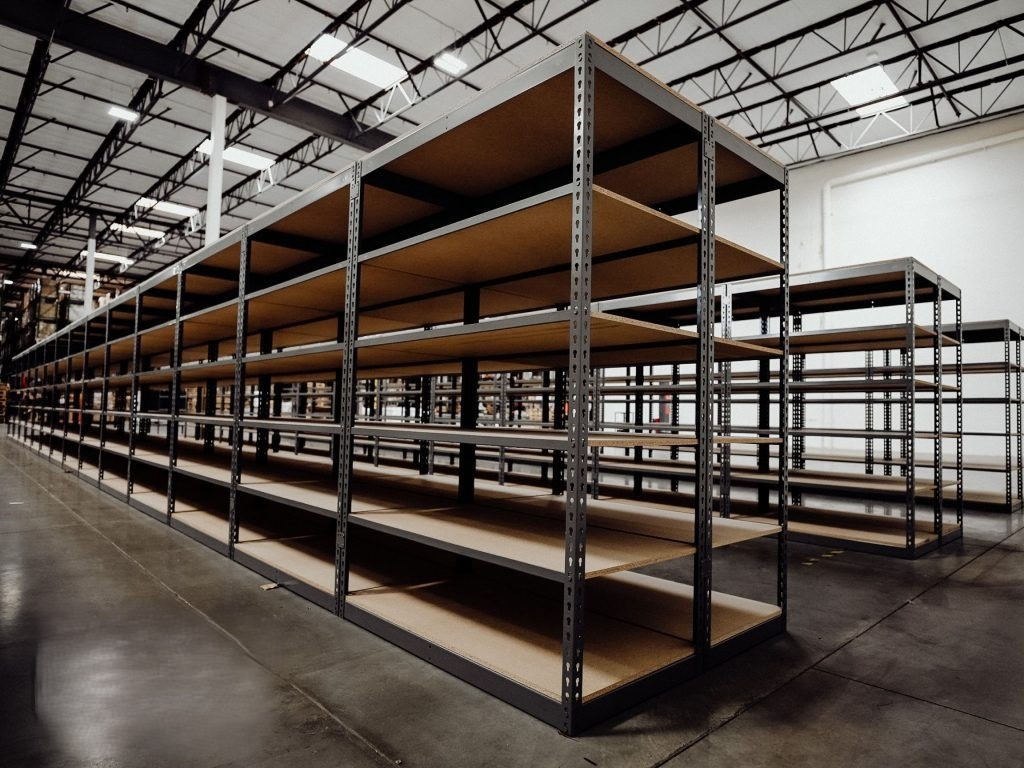
Boltless Shelving Systems – The Foundation of Flexible Storage
When combined with systems like bin shelving, mobile wire shelving, and pallet rack wire decking, boltless shelving turns static storage into a scalable solution. At Shelving Tomorrow, we approach storage as a system design challenge. Let’s start.
What Is Boltless Shelving and Why It’s the Go-To Choice in 2026
Boltless shelving is a modular storage system assembled using a rivet-and-slot design rather than bolts or specialized tools. Uprights and beams lock together quickly, allowing teams to build or reconfigure shelving without downtime. This simplicity is why boltless shelving has become a preferred choice across warehouses, back-of-house retail areas, automotive stock rooms, and industrial facilities.
The real advantage lies in adaptability. Shelves can be raised, lowered, or rearranged as inventory changes. Expansion does not require replacing entire systems. Over time, this reduces layout constraints and lowers total storage costs. Boltless shelving supports growth instead of limiting it, which is why it continues to replace fixed racking in fast-moving operations.
Understanding Boltless Shelving Parts (And Why They Matter)
A boltless shelving system is only as effective as its components. The core boltless shelving parts include upright posts, horizontal beams, shelf decks, and foot plates or reinforcements. Each part is designed to work interchangeably, which is what makes the system scalable.
Upright posts provide vertical strength and determine overall capacity. Beams lock into the uprights and define shelf spacing. Shelves can be steel, particle board, or wire, depending on load requirements and airflow needs. Foot plates stabilize the structure and protect the flooring. Because these parts are modular, damaged components can be replaced without dismantling the entire system. Compared to welded shelving, this significantly extends service life and reduces maintenance costs.
When to Pair Boltless Shelving with Bin Shelving
Some storage challenges are not about bulk inventory but small, fast-moving items. That is where bin shelving becomes a natural partner to boltless shelving. Maintenance departments, pick-and-pack operations, and spare parts storage benefit from clearly segmented bins that prevent mixing and misplacement.
Bins integrate directly within boltless shelving bays, using the same uprights and beams. This creates a single system rather than separate storage islands. The result is faster picking, better SKU visibility, and fewer errors. Bin shelving brings structure to complexity, especially where high item counts meet limited space.
Mobile Wire Shelving for Space-Constrained Operations
When floor space is the primary constraint, mobile wire shelving offers a different approach. Mounted on tracks, mobile systems eliminate fixed aisles and allow shelving units to move as needed. This dramatically increases storage density without expanding square footage.
Mobile wire shelving is commonly used in cold storage, medical facilities, and archive rooms where every meter matters. While boltless shelving works best in open-access environments, mobile systems excel where controlled access is acceptable. Many facilities now use hybrid layouts, combining fixed boltless shelving zones with mobile wire shelving in low-traffic areas to balance access and capacity.
Using Pallet Rack Wire Decking with Boltless Systems
Pallet rack wire decking plays a critical role in safety and compliance. Installed beneath pallet racks or above boltless shelving zones, wire decking provides load support while allowing airflow and visibility. This is especially important for fire safety and inventory inspection.
Wire decking helps prevent items from falling through racks and improves sprinkler effectiveness by allowing water to pass through. In mixed storage environments, it acts as a protective layer between palletized loads and boltless shelving below. As regulations tighten and safety audits increase, pallet rack wire decking is no longer optional. It is a practical upgrade that protects people, products, and property.
Choosing the Right Storage Combination
| Storage Need | Best System | Why It Works |
|---|---|---|
| Fast setup | Boltless shelving | Tool-free installation |
| Small parts | Bin shelving | Organized picking |
| Tight space | Mobile wire shelving | Maximizes floor space |
| Pallet safety | Pallet rack wire decking | Fire and load protection |
Why Businesses Choose Shelving Tomorrow
Shelving Tomorrow works as a storage partner. Every facility has different workflows, load requirements, and growth plans. We offer different configurations of boltless shelving, bin shelving, mobile wire shelving, and pallet rack wire decking to match how your operation actually functions.
We focus on quality materials, scalable layouts, and practical solutions that adapt over time. Whether you are redesigning a warehouse or fine-tuning a stockroom, we help turn storage into a strategic advantage.
FAQs
Is boltless shelving strong enough for warehouses?
Yes. When properly configured, boltless shelving supports heavy loads and performs well in industrial environments.
Can boltless shelving be expanded later?
Yes. Additional bays, shelves, and components can be added without replacing the original system.
What’s better: wire or solid shelves?
It depends on airflow, load type, and hygiene requirements. Each has a specific use case.
Do I need professional installation?
Most boltless shelving systems can be installed in-house, though layout planning is recommended.
Get Started with Smarter Storage
If your storage needs are changing, your shelving should change with them. Shelving Tomorrow helps businesses with flexible systems that grow without disruption. Browse our boltless shelving range, get a tailored quote, or speak with a shelving expert today to build a system that works now and into the future.
 Shelving Tomorrow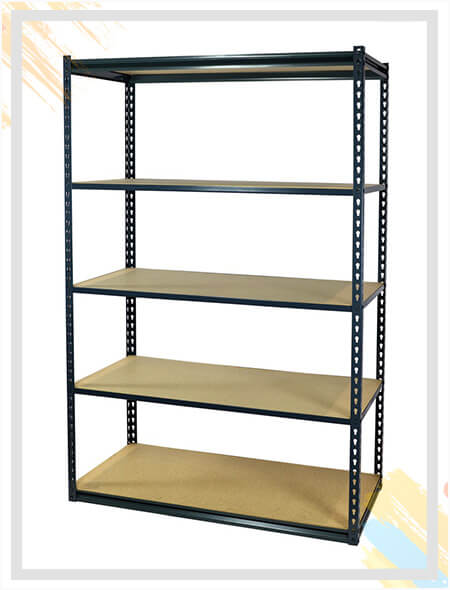

 Shelving Tomorrow
 Copyright © 2018 American Filing Solutions. All Rights Reserved.